Established Clinical Efficacy in FREEDOM-EV1
Orenitram provides clinical intervention for intermediate-risk patients who need improvement of key measures of risk.1-3*

Reduced risk of disease progression1,2

Improved prognostic measures of risk2

Improved key hemodynamic criteria5,6

Dose-response relationship and titratability1,11
*2022 Guidelines define measures of risk as 6MWD, FC, and NT–proBNP.7
Hear from the principal investigator of FREEDOM-EV, R. James White, MD, PhD, who discusses the trial’s key patient characteristics and important outcomes.
Visit the publications library to read the full details of the FREEDOM-EV study
FREEDOM-EV
Assessing the Effect of Orenitram on Time to First Clinical Worsening Event1,2
FREEDOM-EV was an international, multicenter, randomized, double-blind, placebo-controlled, event-driven study.1,2
The Key Baseline Characteristics of Patients in FREEDOM-EV1,5,8
44%
intermediate-low risk||
23%
intermediate-high risk||
79% female
43 years median age
405 m baseline 6MWD
(median)
||Patients in FREEDOM-EV included 32% low risk, 44% intermediate-low risk, 23% intermediate-high risk, and 0.4% high risk. Risk was assessed using 6MWD, FC, and NT-proBNP.2,8
PRIMARY ENDPOINT
Orenitram Is Proven to Delay Disease Progression1
reduced risk of disease progression, resulting in a decreased risk of clinical worsening by 25%1,2¶**
Time to First Clinical Worsening Event (ITT)1
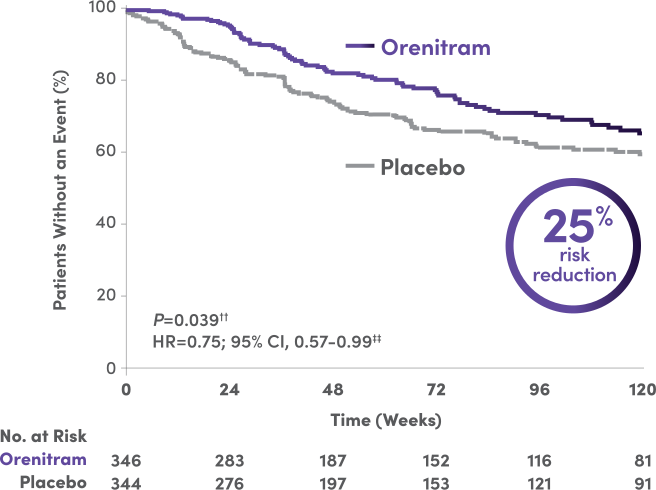
¶Reduction in risk of clinical worsening with Orenitram vs placebo (HR=0.75 [95% CI, 0.57-0.99]; P=0.039). Reduction in risk of disease progression with Orenitram vs placebo (HR=0.39 [95% CI, 0.23-0.66]; P=0.0002).1
**Disease progression was defined as a ≥15% decrease in 6MWD and increase in WHO FC, or as a ≥15% decrease in 6MWD and appearance or worsening of symptoms of right heart failure.4
††P value was calculated with log-rank test stratified by background PAH therapy and baseline 6MWD category.2
‡‡Hazard ratio and 95% CI were calculated with proportional hazard model with treatment, background PAH therapy, and baseline 6MWD as explanatory variables.2
reduced risk of clinical worsening after accounting for the patients’ actual risk status at baseline2¶¶
¶¶Baseline risk-adjusted data are from a post hoc analysis and should be interpreted with caution.
SECONDARY ENDPOINTS
Orenitram Improved Key Prognostic Measures of Risk2,4,5
NT-proBNP
at week 36 vs. placebo‡‡‡
Average 6MWD improvement
at week 48 vs. placebo
Change in 6MWD was not statistically significant at week 24§§§
Improved or maintained WHO FC
at week 24‡‡‡
‡‡‡ 14.7% of patients taking Orenitram improved and 74% maintained WHO FC at week 24 vs. 10.8% improved and 70.9% maintained in the placebo group.
13% more patients taking Orenitram achieved low risk cutoff (NT-proBNP <300 pg/mL) from baseline to week 36.5
§§§ The placebo-adjusted change from baseline in 6MWD at week 24 was +7.5 m (P=0.1411), +12.9 m at week 36 (P=0.0356), and +21.7 m at week 48 (P=0.0015).4
Jean Elwing, MD, discusses the effect of Orenitram on key parameters of risk and overall risk status in FREEDOM-EV.
See More Data on Secondary Endpoints

Higher Doses Achieved Greater Clinical Outcomes10
Reaching the initial target TDD of ≥9 mg achieved greater improvement11
- 6MWD in FREEDOM-EV: +34 m change from baseline at week 48 with ≥3 mg TID (P<0.01) vs. +5 m with <3 mg TID (P=0.56); prespecified11††††
- Borg dyspnea in FREEDOM-EV: 43.5% improved from baseline at week 24 with ≥3 mg TID (P=0.0008) vs. 29.6% in <3 mg TID (P=0.59); prespecified11††††
††††Results are compared for participants achieving an Orenitram dose <3 or ≥3 mg TID at week 24 vs. a common placebo group.11
HEMODYNAMIC SUBSTUDY
Orenitram Improved Key Hemodynamics5,6
The 24-week substudy included 61 patients from FREEDOM-EV who volunteered for a right heart catheterization at baseline and week 24.6
PAC‡‡‡‡
CO‡‡‡‡
CI‡‡‡‡
PVR‡‡‡‡
There were no significant changes to mRAP, mPAP, or mPAWP.5,6
At baseline — PAC: 1.5 mL/mm Hg Orenitram, 1.5 mL/mm Hg placebo; PVR: 581 dynes•sec•cm-5 Orenitram, 653 dynes•sec•cm-5 placebo; CO: 4.9 L/min Orenitram, 4.5 L/min placebo; CI: 2.9 L/min/m2 Orenitram, 2.8 L/min/m2 placebo
Visit the publications library to read about the study5.5 mg vs. 3.6 mg TID
Higher median dose achieved in the hemodynamic substudy (5.5 mg vs. 3.6 mg TID) vs. parent study by week 245,6§§§§
‡‡‡‡Percentage reflects change from baseline (PAC, P=0.007; CO, P=0.005; PVR, P=0.02; CI, P=0.01).6
§§§§Excluded from this analysis (n=6) were those patients with missing or mismatched cardiac output estimates (using indirect Fick or thermodilution methodology) at baseline and week 24. Hemodynamic parameters are expressed as geometric means.6
Improved Risk Status3,12

Patients showed improvements in overall risk assessments as early as week 12 and continued through week 84 in:
- REVEAL Lite 2
- French Noninvasive Method
- REVEAL 2.0
- COMPERA 2.0 ||||||||
|||||||| The use of the French Noninvasive Method risk assessment was a prespecified analysis and REVEAL Lite 2, REVEAL 2.0, and COMPERA were post-hoc risk analyses.3,8
OVERALL RISK STATUS
Orenitram Provided Long-Term Benefits to Overall Risk Status3
A higher percentage of patients (38%) taking Orenitram improved their COMPERA 4-strata risk status than patients on placebo (26%) through 84 weeks.3¶¶¶¶
4-Strata Risk Status: Improvement Over Time

- Patients in FREEDOM-EV included 32% low risk, 44% intermediate-low risk, 23% intermediate-high risk, and 0.4% high risk8
¶¶¶¶Data came from a post hoc analysis of FREEDOM-EV data using the COMPERA 4-strata risk assessment. 35% of patients taking Orenitram improved and 53% maintained risk status at week 24 vs. 20% improved and 53% maintained with placebo. 38% of patients taking Orenitram improved at week 84 and 56% maintained risk status vs. 26% improved and 58% maintained with placebo.3